happenings 4-3
PROTECTED CONTENT
If you’re a current subscriber, log in below. If you would like to subscribe, please click the subscribe tab above.
Username and Password Help
Please enter your email and we will send you a password reset link.
Glenwood will always have a fond spot in my heart. Since I grew up just two miles west of the town, I consider it my home town. As with most rural towns, it had its inception and peak industrial period then a slow decline in population resulting in the lack of businesses one finds in many of these towns today. The late 1800’s were definitely a period of birth and growth for Glenwood.
Much of the information on the history of Glenwood comes from a resource binder which can be viewed at the Schuyler County Historical Society in Lancaster when it opens up on May 1st for the season. R. Keith Kerby, with the assistance of his wife, Nancy Smyser Kerby, wrote the history of Glenwood from 1868-1968. I give credit to them for all their research as I attempt to share some of the history of Glenwood.
The first buildings in the settlement were constructed in 1868. A petition of twenty-nine taxable citizens was presented to the court by John B. Glaze requesting to incorporate the town. The incorporation was granted, so the village of Glenwood had its beginning. After it was founded, it began to prosper rapidly, mostly due to being situated along the North Missouri Railroad (which was later the St. Louis, Kansas City, and Northern Railroad which eventually became the Wabash and finally the Norfolk and Western Railroad). It became a trade center for a rather large area serving both Memphis and Unionville. In only five years, the population grew to 400.
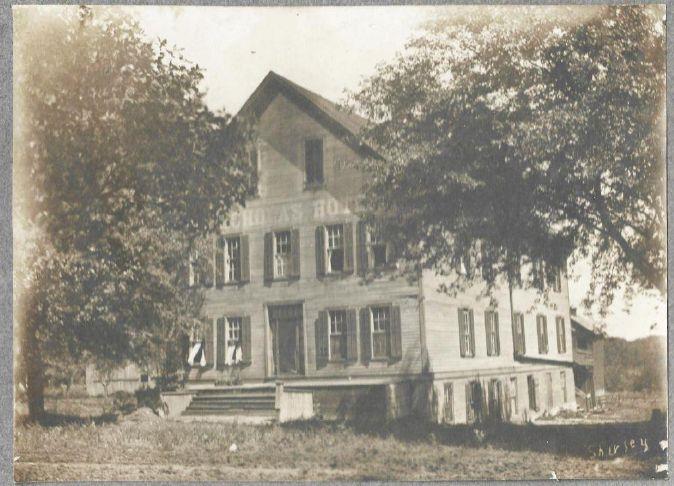
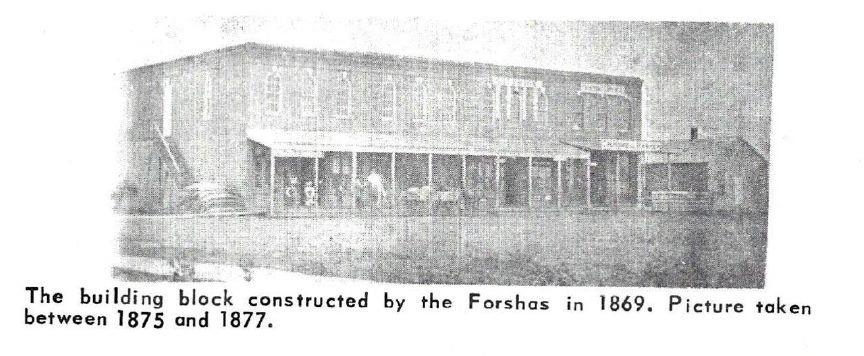
Stiles E. Forsha, and his brother, Alexander are both responsible for building many structures in Glenwood. A couple of the original buildings built by the Forshas in 1869 still stand in Glenwood, although several of their neighboring buildings have met their demise. (See picture of main street.) In 1869 the St. Nicholas Hotel was also constructed by the Forshas. This hotel was of considerable size sporting thirty-nine rooms including the basement. It was deemed “a grand example of architecture…” and was the “…pride of Missouri…” One outstanding feature of the building was a three-story privy with cat-walks from the second and third stories of the building. (See photo)
On the north edge of Glenwood, one would find an area known as “Industrial Hollow” which gave Glenwood the reputation for being one of the leading manufacturing towns in northeast Missouri. There was a flour mill, a woolen mill, a large machine shop and foundry, as well as a hub and spoke factory among other businesses.
The Glenwood Flour Mill was built by Stiles Forsha in 1869; however, it burned a short time later. A Mr. Kutcher, purchased the remnants of the building and machinery and started rebuilding it in 1870. Later it was sold back to Stiles Forsha.
The woolen mill, a three-story building, was built in 1870. It was owned by James R. Buford and a Mr. Neely. They had several carding machines in operation. The mill was able to spin 30,000 pounds of wool per year and wove 100 yards of cloth daily. The mill closed its doors around 1900.
The machine shop was set up by Asaph, Junius, and Camillus Dunbar in 1870. Originally their business was in the basement of the woolen mill, but they constructed two buildings in 1871. One building was for the machine shop, the other was the foundry. In 1871, a large crowd gathered to watch the Dunbar Foundry exhibit its first casting. A variety of pieces of scrap metal were placed in the furnace to melt. This particular casting created a cane mill with a three-roller design. The Dunbar’s chose the Glenwood area for their foundry due to several reasons. First, they expected an east-west railroad to be built in the coming months, a vein of smith coal was available only six miles to the north, and there was significant standing timber available. In addition, Glenwood was situated on the Grand Divide free from malaria fever. Finally, they had access to plentiful molding sand just to the west on the Chariton River.
The hub and spoke factory, owned by Mr. Case also originated in the basement of the woolen mill and was opened in August of 1873. The new facility was constructed in 1874. It was powered by a fifty-horsepower engine with a flywheel eight feet in diameter. Mr. Case hired the Dunbar brothers to cast both the engine and flywheel. In February of 1874 the factory had eight employees.
Another factory that employed a sizable number of people was the hoop-poll factory. Hoop polls were shaped from young saplings for the purpose of holding barrels together. Another large business cut railroad ties.
These industries had great hope for the Missouri, Iowa, and Nebraska rail to join the St. Louis, Kansas City, and Northern Railroad near “Industrial Hollow.” Unfortunately, that did not come to fruition. Instead, it took a northwesterly course and joined about two miles north of the Glenwood business district at a point known as Hombs Crossing. It was there that a depot was built and a town began. That disheartening turn of events most likely caused financial challenges for the young business district. In 1870 they had a contract to provide 50,000 railroad ties. They had a need for many laborers and advertised for fifty ax men and twenty-five teams in 1871.
Although Industrial Hollow was once a thriving business district in Glenwood, today it is just a piece of history as no remnants of the buildings are still in existence. Thankfully, it was documented by the Kerbys so we can pass on a bit of the rich history of Glenwood.
Related Posts