
Historical Happenings
PROTECTED CONTENT
If you’re a current subscriber, log in below. If you would like to subscribe, please click the subscribe tab above.
Username and Password Help
Please enter your email and we will send you a password reset link.
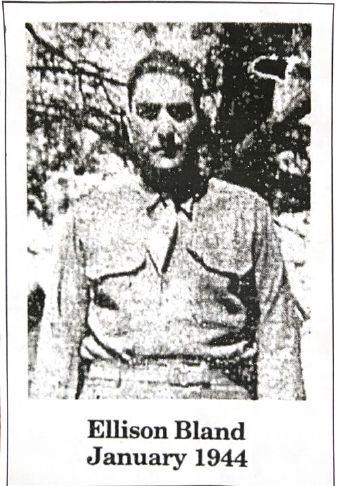
A Father at War: The Story of Ellison Bland
Most people with an interest in World War II history have certainly heard of General George S. Patton. When I was a child, the movie Patton was shown on television every year or two. I remember vividly the scene where he mocked and even struck a frightened soldier. Because of that, Patton did not hold a warm spot in my heart. Although his attitude and fierce determination no doubt cost lives, his brilliant tactical decisions also led to decisive victories that helped bring the war to an end. But what about all those soldiers he commanded? Were any of those men from around here? The answer is yes. I know of at least one for certain.
On December 7, 1941, as Japanese planes bombed Pearl Harbor, Ellison Bland was thirty-two years old, having celebrated his birthday only weeks earlier. At home with his wife, Grace, and their four young children, Ellison worked as a highway foreman and bridge supervisor, ensuring that approaches were safe and well-constructed. He had extensive experience operating heavy machinery such as caterpillars, graders, and trucks, and had also spent several months working on the railroad as a trackman.
As the war dragged on, the demand for manpower grew. It was unusual for men in their thirties with dependents to be drafted, yet Ellison was called to duty on December 29, 1943, at the age of thirty-four. Leaving behind his wife and four children, one might have expected him to be assigned to operate heavy machinery stateside. Instead, Ellison found himself in active combat duty.
He was sent overseas and took part in the Northern France, Rhineland, Ardennes-Alsace, and Central Europe campaigns. Ellison was eventually assigned to Company C of the 704th Tank Destroyer Battalion, which was equipped with the agile M18 “Hellcat” tank destroyers. This battalion was teamed with Patton’s famed 4th Armored Division during the Battle of the Bulge, part of the Ardennes-Alsace campaign. Their mission was to break through to the encircled 101st Airborne Division (and other U.S. units) in Bastogne, a critical road junction in the Ardennes. Control of Bastogne would have enabled the Germans to push westward toward the Meuse River.
On December 19, 1944, Patton received orders to turn his Third Army north. The 704th, alongside the 4th Armored Division, spearheaded the relief effort. In brutal winter conditions between December 22–26, the Hellcats of the 704th helped punch open the southern corridor to Bastogne, fighting through heavily defended towns such as Martelange, Warnach, and Chaumont. On December 26th, Patton’s forces finally broke through, linking up with the 101st Airborne and halting the German counterattack that had threatened to split the Allied lines.
After Bastogne, Ellison and the 704th continued fighting through the bitter winter as Patton’s army pushed the Germans back across their own border. In January and February, the battalion helped crack the formidable Siegfried Line defenses in the Eifel region, battling through snow, mud, and fierce resistance. By early March, Patton’s forces surged into Germany itself, capturing the historic city of Trier and driving rapidly toward the Rhine River. On March 22–24, the 704th crossed the Rhine at Oppenheim in one of Patton’s boldest maneuvers of the war. Immediately afterward, they spearheaded the push east toward Hanau, fighting in scattered but intense engagements. It was during this fast-paced drive across central Germany, on March 26, 1945, that Ellison was wounded in action.
Now thirty-five years old, Ellison received a Purple Heart on March 27, 1945, at the 39th Evacuation Hospital. In addition, he was awarded the EAME Theater Ribbon with three battle stars, as well as the American Theater Ribbon. The entire 4th Armored Division also received a special commendation from General Patton himself:
“The outstanding celerity of your movement and the unremitting, vicious, and skillful manner in which you pushed the attack, terminating at the end of four days and nights of incessant battle in the relief of BASTOGNE, constitute one of the finest chapters in the glorious history of the U.S. Army.
You and the officers and men of your Command are hereby highly commended for your superior performance.
You will apprize all units concerned of the contents of this letter.”
— G. S. Patton, Jr., Lieutenant General, U.S. Army Commanding
Nine months later, Ellison was discharged from O’Reilly General Hospital in Springfield, Missouri, on January 18, 1946, at the age of thirty-six. Returning home to recuperate, he found that his injuries made it difficult to continue the work he had done before the war. He eventually found employment with Sloops Produce, driving trucks and loading produce. After Sloops closed, he went to work for Drury Produce.
It is easy to see why Ellison’s wife, Grace, became such an accomplished gardener. During his absence she had carried the burden of raising their four children while also growing the food and tending the animals needed to feed the family. Today, we thank not only Ellison for his sacrifice, but also Grace and their entire family, who bore the weight of war on the home front.


