Teal Season Kicks Off Fall Waterfowl Seasons
PROTECTED CONTENT
If you’re a current subscriber, log in below. If you would like to subscribe, please click the subscribe tab above.
Username and Password Help
Please enter your email and we will send you a password reset link.
There are times when everyone gets tied up with other things in life. On the opening day of the early teal season a couple of years ago, that was the case for us. Following a couple of surgeries a few years back, my wife said she would feel better if I didn’t hunt alone—especially if I was going to be out on the river. It seemed like a sensible request, so I agreed, but I added that I had no intention of reducing my time in the duck blind or in the field. Therefore, since she didn’t want me to hunt alone, she joined me.
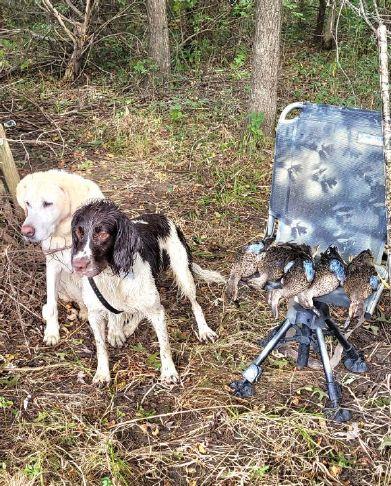
That year, when everyone else was busy or working, she and I kicked off the waterfowl season together with opening day of the special early teal season. We took both dogs so that if we got lucky and took a couple of teal, they would both get an opportunity to retrieve.
When we arrived at the site of my blind, we set up a wall blind I had been given a few years back instead of using the permanent blind. The best way to describe it is that it is one wall of a hub blind that pops open, is staked out, and you sit behind it. We brought a couple of folding chairs to sit on. The reason for not using the permanent blind was that wasps had made it their home all summer and had not yet been evicted. I planned to wage my chemical attack on them after the hunt.
Once the wall blind was in place, I tossed out about 30 decoys, including two dozen teal decoys and some mallard hen decoys to be more visible to any teal that might be buzzing the lake. We started a couple of Thermacell units to keep mosquitoes at bay and waited for sunrise. We were encouraged to see a bunch of teal go down the center of the lake and even more so when a smaller group entered the lake.
The success of the special teal season depends on the states above us having a cool early fall, which pushes teal to migrate south. Just seeing the small ducks gave us hope for some action.
Although it was light enough to shoot when that smaller group came in, we couldn’t because shooting hours are different from the regular waterfowl season. During the special early teal season, shooting runs from sunrise rather than the normal half-hour before sunrise. The delayed start helps hunters avoid mistaking other waterfowl for teal. In September, there are usually many local wood ducks as well as some early migrating shovelers.
As shooting time approached, we called to the small band of teal. Although teal can be challenging to call in, this group landed right in our decoy spread. We sat quietly and watched as they fed along the shoreline vegetation. We were both using 20-gauge shotguns—Paula with a CZ semi-auto and me with a Silver Reserve II. When the time came to jump them, I let my wife have the first shot. She dropped her first waterfowl ever. I missed my first shot but connected on my second, and we ended the morning with four teal. Both dogs got to retrieve and happily cooled off in the water.
Growing up near Rose Pond, the teal season opener was something special. It followed the dove season opener, and a perfect day could be teal in the morning, doves midmorning, and squirrels in the late afternoon. Teal hunting was, and is, the first waterfowl season of fall.
If you already duck hunt, you have all you need. You’ll be in shallow water and will need a way to stay dry—either a boat or boots. A 3½-inch magnum load isn’t necessary; I use 2¾- or 3-inch non-toxic No. 4 shot. The same load works during the early part of the regular duck season before birds are fully feathered. I also use it to finish wounded birds rather than wasting more expensive shells.
For the 20-gauge, I use a modified or full choke tube to tighten the pattern. Mallard decoys work fine, though I’ve collected 2½ dozen teal decoys over the years. In September, most ducks aren’t in winter plumage, so I mix in old hen mallard decoys for realism. Light winds often leave decoys motionless, so I use a Mojo teal decoy, a Higdon floating flasher, and several flock-a-flickers for motion.
A regular mallard call will work for teal, though teal calls are higher pitched, raspier, and faster. If you want a dedicated teal call, I recommend Haydel’s, Buck Gardner’s, or Duck Commander’s models. Practice often. Ducks Unlimited’s website has recordings for reference.
Finally, don’t forget your permits and stamps. In Missouri, that means a small-game hunting permit, a state migratory bird permit, and a federal duck stamp. This year, the season runs Sept. 13–21, shorter than past years due to a slight decline in blue-winged teal populations. Shooting hours are from sunrise to sunset. The daily bag limit is six teal—blue-winged, green-winged, or cinnamon.
Because of the warm September weather, it’s an ideal time to introduce younger hunters to waterfowling before the cold of late November and December.