
More Than a Name on Stone: The Courage of Lt. Ellen Ainsworth
PROTECTED CONTENT
If you’re a current subscriber, log in below. If you would like to subscribe, please click the subscribe tab above.
Username and Password Help
Please enter your email and we will send you a password reset link.
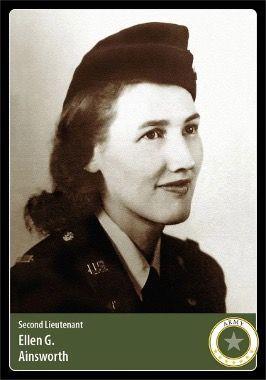
During the Historical Society’s July focus on the 1940s, I set myself a mission: to learn more about the names engraved on the monument at the southeast corner of the courthouse lawn. These names represent people who sacrificed everything in service to our country during various wars. Just as with the memorials in Washington, D.C., and elsewhere, I wanted these men and women to be more than just names on a wall. So, I began researching. Since our spotlight was on the 1940s, my focus turned to those lost during World War II. Some names left me with more questions than answers—particularly when I could not find how the individual was connected to Schuyler County. Perhaps readers of this column can help shed light on those. Most of the names, however, revealed deep ties to our county.
The first name on the list is that of a woman: Ellen G. Ainsworth. She is a heroine in the truest sense of the word, yet I have not been able to find her connection to Schuyler County, Missouri. Ellen was born on a family farm in Menomonie, Wisconsin, on March 9, 1919. In 1923, her family moved to Glenwood City, Wisconsin. Hoping to see the world, she joined the Army Nurse Corps in 1942 after graduating from nursing school in Minneapolis the year before. She was assigned to the 56th Evacuation Hospital at Fort Sam Houston, Texas. From there, her unit was sent first to Morocco, then Tunisia, followed by Salerno, Italy. Her final assignment was in Anzio, Italy, where fierce and unrelenting battles raged. Over four months, the hospital tents at Anzio were under constant attack and became grimly known as “Hell’s Half Acre.” Dozens of patients, medics, and physicians were killed there—including six nurses.
On February 10, 1944, the 56th Evacuation Hospital came under heavy bombardment. Most nurses and hospital staff rushed patients to bunkers, but some patients were too badly injured to be moved. Lt. Ellen Ainsworth chose to stay with them. According to eyewitnesses, she remained calm as she placed her 42 patients on the ground, doing everything she could to keep them safe. On February 12, a German artillery round exploded just outside her ward tent, mortally wounding her. Four days later, she succumbed to her injuries at the age of 24. Tragically, her family in Glenwood City received the news on March 9—what would have been her 25th birthday.
For her bravery, Lt. Ainsworth was posthumously awarded the Bronze Star, the nation’s third-highest decoration for valor in combat. She now rests at the Sicily-Rome American Cemetery in Nettuno, Italy, alongside 7,844 fellow Americans (Plot C, Row 11, Grave 22).
We extend our deepest gratitude for her service and sacrifice, and our heartfelt condolences to her loved ones.
If you know of Ellen’s connection to Schuyler County, please reach out to me via Facebook Messenger, email ([email protected]), or by landline (number listed in the directory).
Much of the background on Lt. Ellen G. Ainsworth—her service with the 56th Evacuation Hospital, her final assignment at Anzio, and her courageous actions under fire, and her photo—was drawn from the biography featured on the Hero Cards website, produced by The Grateful Nation Project (herocards.us).
Photo courtesy of www.herocards and the U.S. Army


